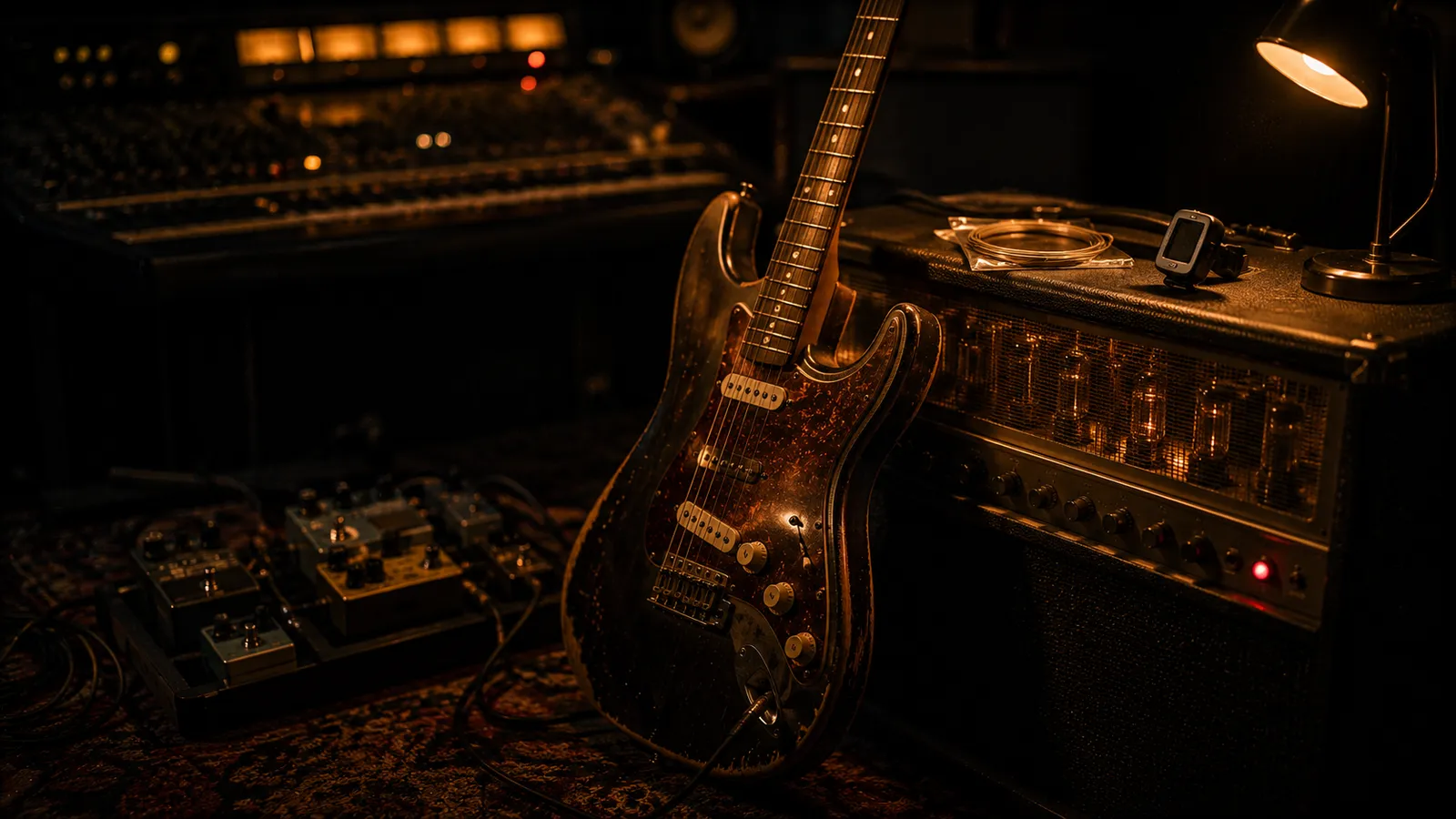
A great guitar tone on record is rarely a studio trick. It's a good instrument, in tune, played through gear that's quiet and healthy, at a volume where it actually sounds like itself. Everything I do at the board is there to capture that tone honestly — not invent one that isn't in the room. So the prep work is worth as much as anything that happens after you plug in.
Here's how to get your rig ready before you get here.
Change your strings ahead of time, not the day of
Fresh strings sound brighter and hold tuning better, but brand-new strings also stretch and settle for a day or two before they're stable. Change them the night before, not the morning of. Give them a full session of playing and re-tuning at home so they've already done their stretching by the time you're in front of a mic. Showing up with strings you put on an hour ago means fighting tuning drift all session instead of playing.
Get your intonation and setup checked
If your guitar buzzes on certain frets, won't stay in tune up the neck, or has intonation that's off enough that chords sound sour in different positions, that's worth a trip to a tech before your session, not something to work around in the room. A proper setup — action, intonation, neck relief — makes every note you play sound more like you intended. This is a source problem, and no amount of studio processing fixes an instrument that isn't set up right.
Hunt down noisy pedals and cables
Buzzing pedals, crackly patch cables, a noisy power supply — these all show up in a recording far more obviously than they do live in a room full of other sound. Before your session, run your full signal chain through headphones at home and listen for hum, crackle, or dropouts. A cheap cable swap or a fresh 9V battery can save real time once you're tracking. If something in your chain is noisy and there's no time to source a replacement, tell me — we can often route around it.
Bring backups
Strings, picks, a spare cable, extra batteries for pedals — pack them like you would for a gig. A broken string or a dead battery mid-session is a normal, fixable hiccup if you've got a backup in your bag. It's a much bigger interruption if you don't.
Know your amp's actual sweet spot
Every amp has a volume and gain range where it sounds most like itself — usually where the power tubes (if it has them) start to work a little, not screaming, not whisper-quiet. Spend time at home finding that spot for the tones you want on this record. Come in already knowing "this is my clean sound, this is my crunch, this is my lead tone" rather than discovering it for the first time in the room.
Dial tones at performance volume
A guitar tone that sounds perfect at bedroom volume through headphones can behave completely differently once an amp is actually pushing air at the volume you'll play the take at. If possible, do at least some of your at-home tone-chasing at a volume closer to how you'll actually perform the song — palm mutes, dynamics, and pick attack all read differently when you're playing for real instead of quietly noodling.
Studio options versus your live rig
Revolutionary Recordings runs on the Universal Audio Apollo ecosystem, which gives us flexibility in how we capture and shape a guitar signal once it's recorded. That means we have options: mic your amp directly, record a DI alongside it for reamping later, or both. Reamping is worth discussing if you want to experiment with tones after the take is already committed, or if you're not fully sure yet which amp setting is the one. But none of that replaces bringing an instrument that's set up right and a rig that's quiet — the flexibility on the back end is there to expand your options, not to compensate for problems that were avoidable going in.
The takeaway
Guitar tone is decided long before a mic gets placed. Fresh strings the night before, an instrument that's properly set up, a rig free of noise, backups in your bag, and tones dialed at real performance volume — do that work at home, and the rest of the session is about capturing a great sound instead of chasing one down.
Bring your rig prepped and we'll spend the session on tone, not troubleshooting. Revolutionary Recordings has tracked guitarists across the Mid-Atlantic since 2006. Book a session.