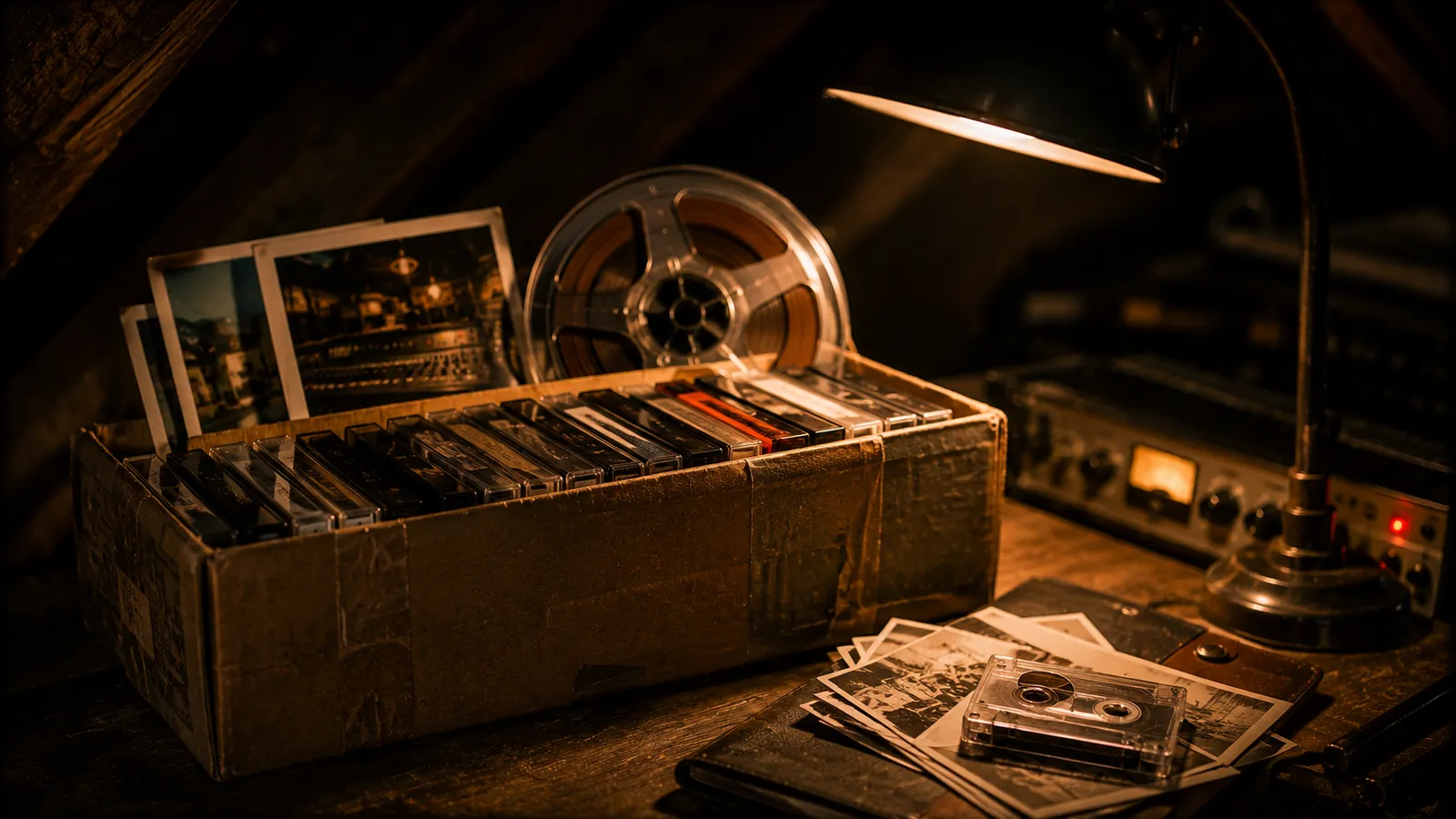
The holidays bring people back into old houses, and old houses have attics. Somebody always ends up down there this time of year, and somebody always finds the box — cassettes from a garage band, a reel from a wedding, a stack of vinyl that never made the move to digital, a grandparent's voice on a home recording nobody's heard in decades. That box has been quietly losing ground the whole time it's been sitting there. Get it digitized before the holidays and you don't just save the audio — you've got something worth putting in front of the whole family.
What's actually happening inside that box
Cassettes and reels aren't inert just because they're sitting still. Tape binder — the material that holds the magnetic layer onto the plastic backing — breaks down over years, and in humid attics and basements that breakdown accelerates. Reels stored tightly wound for decades can develop print-through, where the magnetic signal on one wrap of tape faintly bleeds onto the wrap next to it, showing up as a ghost echo of a loud passage a few seconds before or after it actually happens. Damp storage invites mold, which can be genuinely unpleasant to handle without the right precautions and can render tape unplayable if it's gone far enough. Vinyl holds up better in dry storage, but warping from heat and wear from every play still take a toll, especially on records that only ever existed as one pressing. For a broader look at how analog media ages in general, see Your Old Tapes Won't Last Forever.
What restoration can — and can't — bring back
Once the transfer itself is done, restoration is the honest next question: how much of what time took can we get back? Hiss, hum, clicks, and a lot of tape noise respond well to careful cleanup — often more than people expect. Dropouts, where a section of tape has genuinely lost its magnetic signal, are trickier; sometimes we can rebuild around a short one, and sometimes a gap is a gap, and I'll tell you that straight rather than promise a fix I can't deliver. The goal is always getting a recording as close as honestly possible to how it sounded when it was made — not manufacturing something that was never there.
Turn it into the gift itself
A digitized recording of a grandparent's voice, an old family band, or a wedding nobody has audio of anymore is a genuinely different kind of gift — the kind that can't be bought new, only recovered. Families often split it as a group project: one person tracks down the box, a few others chip in, and everyone gets a copy at the same gathering where the box first got mentioned. If there's a specific recording you want ready in time for the holidays, the sooner you get it to me the better — get in touch and let's get it queued now rather than the week you actually need it.
After the transfer, take care of the originals
Digitizing doesn't mean the physical tapes and records are disposable — plenty of people rightly want to keep them. Once they're transferred, store them somewhere cool, dry, and out of direct light; a closet inside the house beats an attic or basement every time. Keep tapes upright rather than stacked flat, and away from anything with a magnet in it. The digital files are now the safety net; the originals can rest instead of carrying all the risk alone.
The takeaway
That box in the attic isn't getting any younger, and neither is the recording inside it. Get it transferred, be honest with yourself about what restoration can and can't fix, and turn what was sitting in a box into something the whole family can actually hear again. It's one of the more meaningful things you can hand someone over the holidays.
Got a box of family tape or vinyl in the Philadelphia metro or the wider Mid-Atlantic? Revolutionary Recordings has been transferring and restoring analog audio since 2006. Book a session and let's get it safe before the holidays.