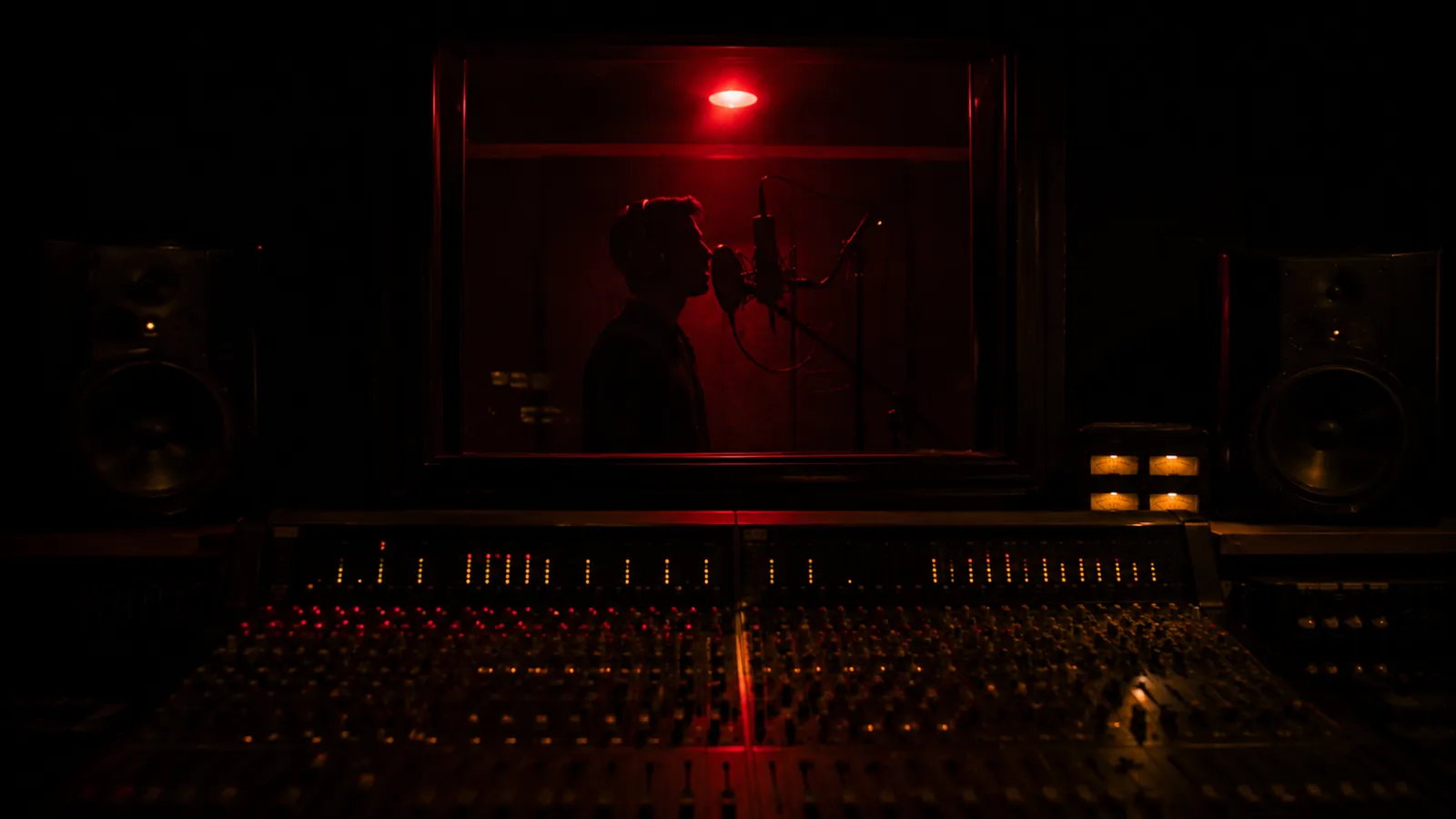
There's a phenomenon every engineer knows. An artist plays a song flawlessly while we're setting levels — loose, expressive, alive. Then I say "okay, this one's recording," and the same person tightens up, rushes the chorus, and loses the very thing that made it special. The red light does that. The good news: it's manageable, and once you understand why it happens, you can beat it.
Why the booth flattens performances
When you know you're being captured, your brain shifts from performing to avoiding mistakes. Those are different mental modes, and the second one is poison to feel. You stop leaning into phrases. You play it safe. Safe is technically clean and emotionally dead — and a record needs the opposite.
The fix isn't to care less. It's to get your body and mind into performance mode and keep them there.
Warm up like it counts
Don't make the first thing you record cold be the hardest thing you'll play all day. Warm up properly — physically and musically. Run easy material first. Get your hands, or your voice, fully online before we point a mic at the demanding stuff. A warm performer takes risks; a cold one protects.
Let the scratch take carry the pressure
We almost always record a scratch take first — a reference pass that won't be the final. Knowing a take "doesn't count" is liberating, and here's the trick: scratch takes are often magic precisely because you weren't guarding. More than once I've kept a scratch vocal over every careful take that followed, because it had something the others chased and missed. Play the scratch like it's real and you'll frequently find you've already got the keeper.
Energy beats perfection
A take with a tiny flaw and real fire will move a listener. A flawless, lifeless take won't. Listeners don't hear the slightly-late note you're obsessing over; they hear conviction or the lack of it. When I'm choosing between "perfect and flat" and "human and electric," I take electric every time, and you should too. Commit to the performance. We can fix a clam. We can't fake belief.
Don't over-track
There's a point of diminishing returns where take 14 is worse than take 3 because you're tired, frustrated, and overthinking. I watch for it. When I hear it creeping in, we stop, move to another song, or take five. Chasing a take past the point of freshness wrecks more sessions than nerves do. Sometimes the best thing you can do for a song is walk away from it for twenty minutes.
Use comping, but don't hide behind it
Comping — building one strong take from the best moments of several — is a normal, legitimate part of modern recording. We'll use it. But it works best as a way to assemble committed performances, not to stitch together a dozen timid ones. Give me three or four full-hearted passes and I have great raw material to build from. Give me twelve careful ones and there's nothing in any of them to keep.
Set the room up for comfort
Performance is physical and emotional, so the environment matters. A headphone mix that actually feels good to sing or play over is worth more than any plugin — if you can't hear yourself comfortably, you'll fight the take. Tell me what you need in your cans. Want the lights down? Want to face away from the glass? Want everyone out of the control room for the vulnerable vocal? Say so. None of it is a strange request. My whole job is to make the room disappear so you can perform.
You're not being judged
This is the one I most want first-timers to hear. When a take doesn't work, it's not a verdict on your talent — it's the process doing what it does. Working one-on-one, no assistants, no audience, means the only person in the room is the person trying to help you sound your best. There's nobody to impress. There's just the song. Get comfortable, get warm, commit — and we'll catch the take that captures you.
Revolutionary Recordings has helped Mid-Atlantic artists deliver their best performances since 2006, with one engineer start to finish. Let's make your record.