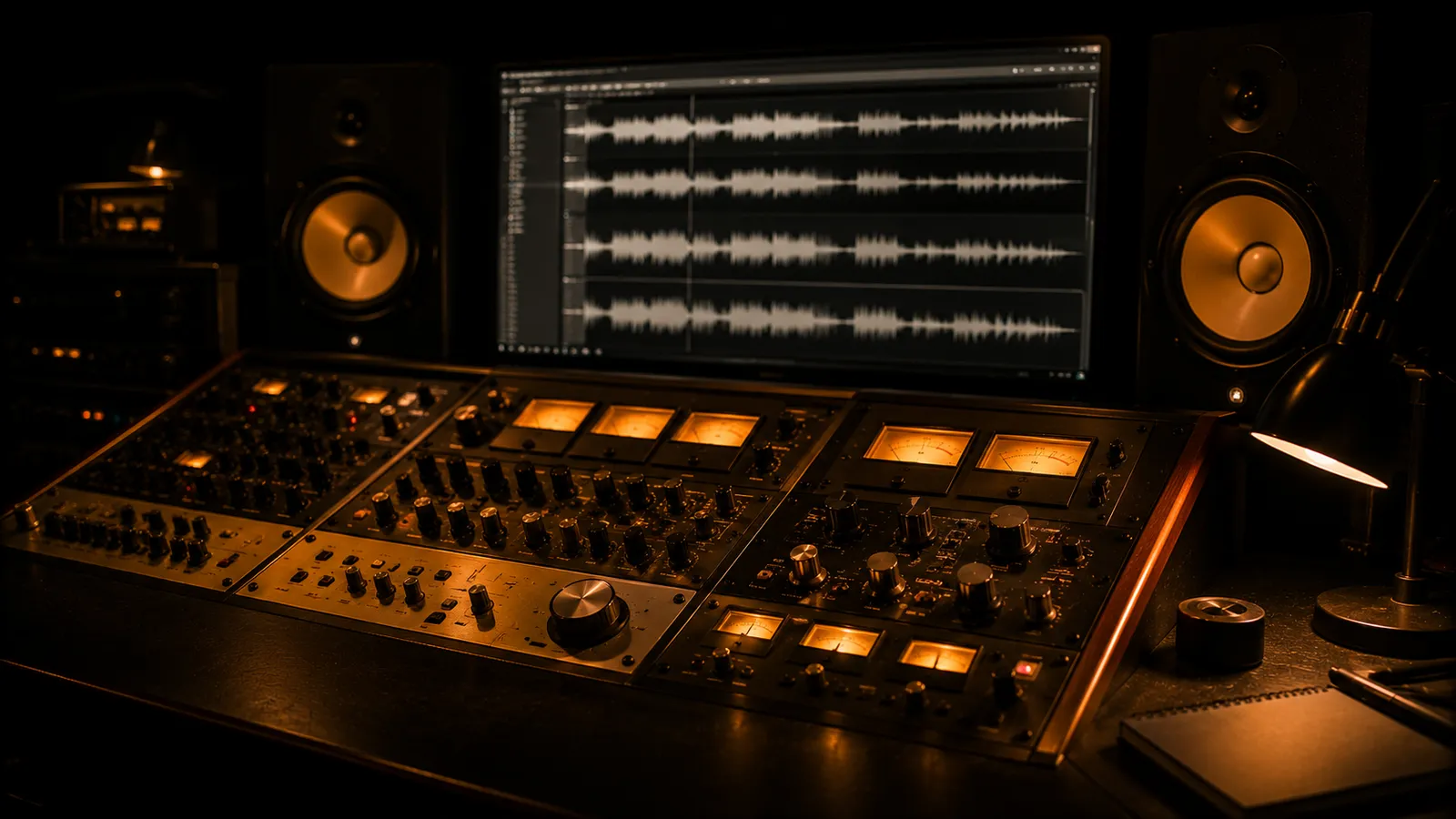
I get some version of this question almost every week: "Do I need stem mastering, or is regular mastering enough?" It's a fair thing to wonder, because most artists have heard the term "stem mastering" without ever getting a clear answer on what it actually buys you. Short version: both are mastering. The difference is what I'm working with when I do it.
I covered the basics of mastering in What Mastering Actually Does — this post goes deeper on the standard-vs-stem decision specifically, because it's worth understanding before you export anything.
Standard mastering, in plain terms
Standard mastering starts with one file: your final stereo mix, bounced down exactly as it should sound. I treat that mix as a finished object — EQ, dynamics, and level decisions are made across the whole thing at once, the same way you'd adjust a finished photograph rather than repainting parts of it. It's the right process for the vast majority of songs, because most mixes arrive in good shape and just need that last pass of translation and polish.
This is also the simpler path logistically. One file, one set of decisions, and a first sample back to you quickly for approval.
Stem mastering, in plain terms
Stem mastering starts with several files instead of one — grouped stems like drums, bass, music, and vocals, each bounced from the same mix session, starting at the same point in the timeline. Instead of processing one stereo file, I can still shape the track as a whole and nudge the balance between those groups where the mix needs it. A vocal that's just a hair too far back, a bass that wants a touch more presence under the master bus processing — that kind of adjustment is possible with stems in a way it simply isn't with a finished stereo file.
It's still mastering, not remixing. I'm not rebuilding the arrangement or re-EQing individual instruments inside a stem. I'm using a small number of broad groups to solve a specific balance problem while doing everything standard mastering does.
When standard mastering is the right call
If your mix is genuinely finished — you've lived with it, made your revisions, and you're happy with the balance — standard mastering is what you want. It's faster, it's simpler, and for a mix that's already doing its job, adding stem-level control doesn't improve anything. More knobs aren't better when nothing needs turning.
When stem mastering earns its keep
Stem mastering is the right call in a specific, recognizable situation: the mix is 90% there, but one element has a relationship to the rest of the track that isn't quite working, and reopening the mix session isn't practical. Maybe the mixing engineer has moved on to another project, maybe the session lives on a machine you no longer have access to, maybe it's simply more efficient to solve a small problem at the mastering stage than to restart a mix revision cycle for it. Stem mastering lets me get at exactly that kind of issue without a full remix.
It's also useful when you know, going in, that you want a bit more shaping latitude than a stereo master allows — some genres and some artists like having that flexibility built into the process from the start rather than treating it as a fallback.
What stem mastering is not is a substitute for a mix that has real problems. If the vocal is genuinely buried under everything else, or the low end is a structural mess, that's a mix-level fix, not a mastering-level nudge — stems or no stems. I'll tell you honestly if that's what I'm hearing.
What to deliver for each
For standard mastering, send the final stereo mix as a high-resolution WAV or AIFF, with a bit of headroom before the true peak (no limiter squashing it flat before it reaches me) and no fades baked in at the front or back.
For stem mastering, export your grouped stems — typically four to six groups depending on the track — all starting at the same timeline position, all the same sample rate and bit depth, with consistent naming so nothing gets mixed up (drums, bass, music/instruments, lead vocal, backing vocals is a common split). Same rule applies: leave headroom, and don't print any master-bus processing onto the stems themselves.
If you're not sure how your stems should be organized for your specific song, send me a rough version of what you're thinking and I'll tell you what to adjust before you do a final export.
Not sure which one you need?
Send the mix over and tell me where you feel unsure about it. I'll listen and give you an honest read — sometimes that's "this is ready for standard mastering," sometimes it's "let's do stems because of X," and sometimes it's "let's touch up the mix first, because that's what will actually fix this." That conversation costs you nothing and saves you from guessing.
The takeaway
Standard mastering treats your finished mix as a whole. Stem mastering gives me targeted control over a handful of groups within it, for the cases where a stereo file can't quite get you there. Neither one rescues a mix with real problems — that's still a mix-level fix. Full pricing and details for both live on the services page, and if you want a straight answer on which one your track needs, get in touch.
Mixing and mastering independent releases across the Philadelphia metro and the Mid-Atlantic since 2006 — book a session and let's figure out the right path for your track.