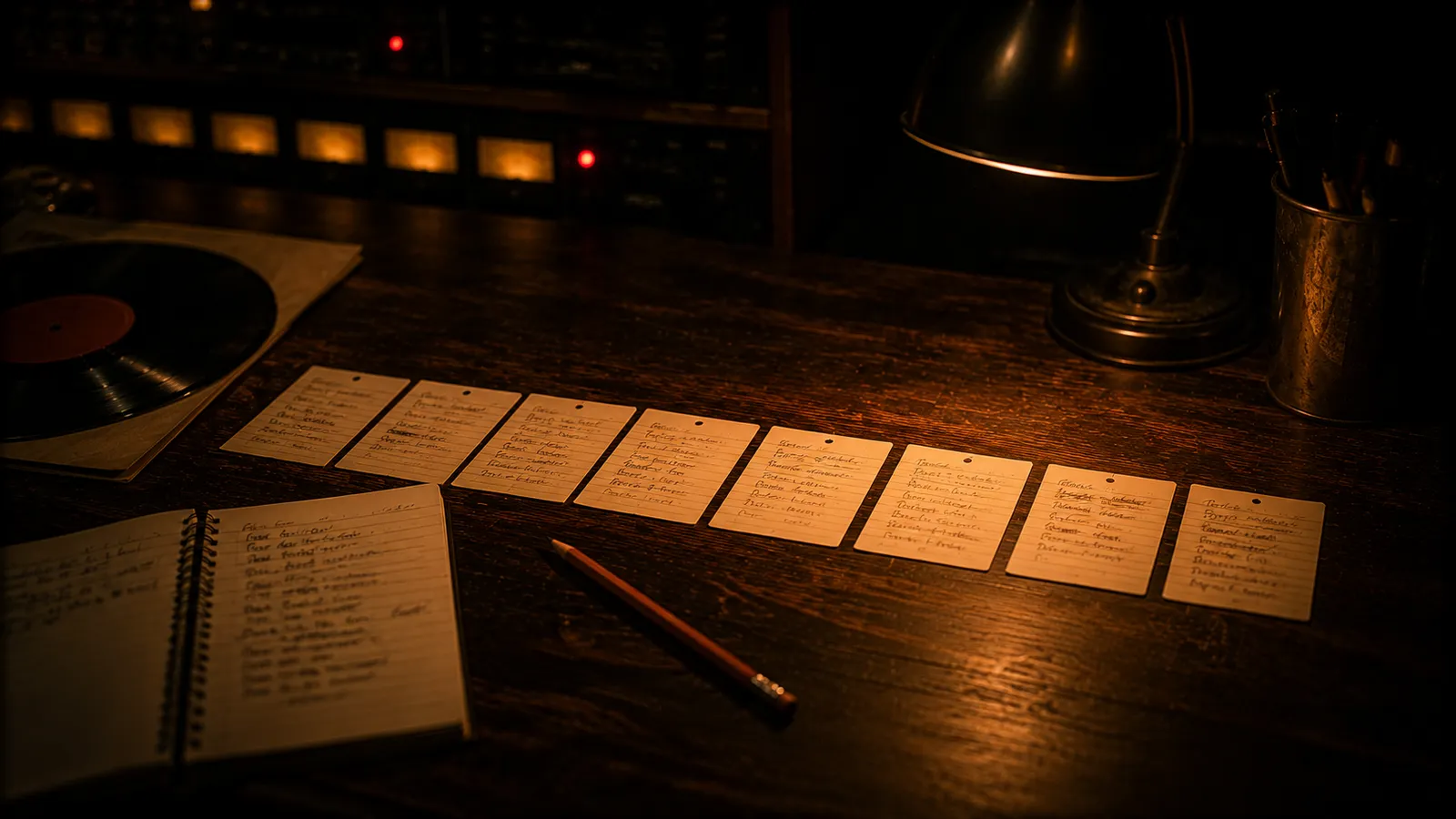
Artists spend months on the songs and then decide the track order in about ten minutes, usually the night before the files go out the door. I understand the impulse — by that point you're exhausted and just want it done — but sequencing is one of the cheapest, most consequential decisions left in the whole process. It costs no studio time and no extra takes, and it changes how the entire release is experienced.
Your opener is a contract
The first track sets an expectation the rest of the release either honors or fights. It doesn't have to be your single or your most "impressive" song — it has to be the song that tells a new listener what kind of record this is and makes them want the next track. A slow, patient opener works fine if the whole record is patient. It works badly if track two suddenly changes the rules. Pick the opener for what it promises, not just for what it shows off.
Think in arcs, not just song order
A good tracklist has an energy arc — places where it lifts, places where it settles — rather than a flat line of similarly-paced songs back to back. Two high-energy tracks in a row can work; five in a row usually exhausts a listener before the record's halfway done. Look at your songs by tempo and intensity, not just genre, and ask where the ear needs a breath. A quieter track placed right after a peak can land harder than if you'd buried it at track nine out of habit.
Watch the seams between songs
Adjacent tracks talk to each other, especially in key and tempo. A song in a bright major key can feel jarring dropped right after a slow minor-key ballad, even if both songs are strong on their own. It's not a hard rule — a deliberate contrast can be the whole point — but it should be a choice, not an accident you notice for the first time on the drive home after release day. Pull up your songs' keys and tempos side by side before you commit to an order and look for transitions that feel abrupt for no reason.
Mind the deep-cut valley
Every multi-song release has a stretch in the middle where attention naturally dips — call it the deep-cut valley. It's not a flaw; it's just how listening works. The mistake is stacking your three weakest songs back to back right in that stretch, guaranteeing the release loses momentum exactly when it's most vulnerable. Instead, spread your quieter or more experimental tracks so at least one strong, grabby song sits inside that middle stretch to pull attention back.
Closers do different work than openers
An opener has to hook a stranger. A closer only has to satisfy someone who's already forty minutes in — that's a different job, and it lets you take more risks. Some of the best closing tracks are the ones that wouldn't have worked anywhere else on the record: longer, stranger, quieter, or simply less immediate. If you have a song like that, the end of the tracklist is often exactly where it belongs.
Streaming changes the math, but doesn't erase it
Playlists and shuffle mean a meaningful share of listeners will hear your songs out of order, or hear one song in isolation pulled onto someone else's playlist. That's real, and it's part of why every individual track still has to stand on its own. But it doesn't mean sequencing is pointless — it means you're sequencing for two audiences at once: the listener who presses play on the whole thing start to finish (still a real and valuable listener), and the one who only ever hears track four. Good sequencing serves both; it doesn't sacrifice one for the other.
Vinyl sides are their own decision
If you're pressing to vinyl, sequencing gets an extra layer: each side is its own mini-arc with its own opener and closer, and the physical flip is a real pause you get to use. A song that closes side A hard, followed by a fresh start on side B, is a different experience than the same two songs sitting back to back on a streaming playlist. If vinyl is part of your plan, think about your side breaks early — they can genuinely change which running order feels right.
Spacing and gaps happen at mastering
Once the order is set, the fine detail work — how much silence sits between tracks, whether one song crossfades or bleeds into the next, level-matching so the whole thing doesn't lurch in volume from song to song — gets handled at the mastering stage. That's part of what turns a folder of finished songs into a record that plays like one continuous listen instead of a stack of unrelated files. If you haven't read it yet, The Master Is Done — Now What? picks up the release-planning conversation from there.
The takeaway
Track order isn't an afterthought — it's the last piece of storytelling you get to do before the record leaves your hands. Think about what your opener promises, where the energy needs to breathe, which songs sit uneasily next to each other, and where your closer can afford to take a risk. Do that work deliberately, and the same eight or ten songs will play like a considered record instead of a shuffled folder.
Bringing records together in the Philadelphia metro and across the Mid-Atlantic since 2006 — if you're finishing a release and want a second opinion on the running order, book a session.