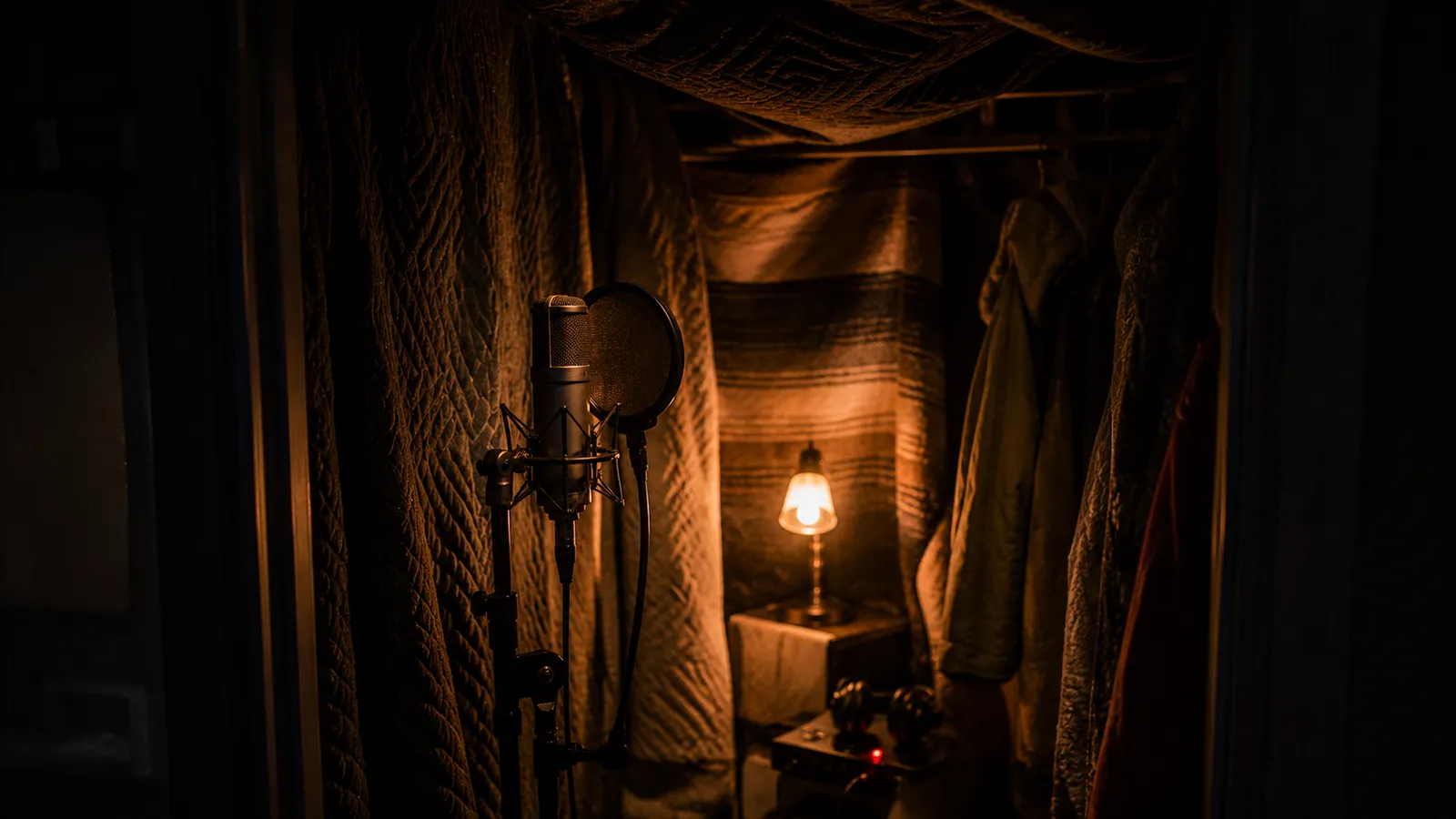
Podcasters send me two kinds of audio problems, and only one of them is fixable after the fact. Noise, a slightly harsh mic, an inconsistent level — I can work with those. A room that's bouncing every word back on itself is a different story, and it's the single most common issue I run into. If you take one piece of advice from this whole post, take this one: solve the room before you upgrade the mic.
Why the room beats the mic every time
A microphone's job is to faithfully capture whatever sound arrives at it. That's exactly the problem — in an untreated room, what arrives at the mic isn't just your voice, it's your voice plus a wash of reflections bouncing off bare walls, windows, and hard floors. A better mic just captures that echo in higher fidelity. It doesn't remove it. Meanwhile, a modest mic in a well-treated room, recorded close, will sound cleaner and more professional than an expensive mic in a boomy spare bedroom every single time. Room first, mic second — always in that order.
Find the deadest space you already have
You don't need a purpose-built booth. Closets full of hanging clothes are close to ideal — soft fabric on every side, no parallel hard walls, and usually small enough that reflections have nowhere to build up. Small carpeted rooms with soft furniture work well too. If you're stuck recording in a larger or harder-surfaced room, a blanket fort or a heavy duvet draped on a rack or hung behind and around you does more good than it has any right to. The goal isn't studio-grade treatment — it's breaking up hard, flat, parallel surfaces near the mic so sound doesn't have a clean path to bounce off and back.
A quick test: clap once in the room, right where you'll be sitting. If you hear a ringing tail after the clap, the room needs help. If it dies almost instantly, you're in decent shape.
Get close, and stay close
Distance from the mic does more work than most people expect. The farther you sit from the microphone, the more room sound gets picked up relative to your voice — even in a treated space. Aim for roughly a fist's distance to a hand's-width away, off-axis enough to avoid harsh plosives on your P's and B's (a cheap foam windscreen or a pop filter handles most of that). Getting close also means you can talk at a natural, relaxed volume instead of straining toward a mic that's too far away, which affects your delivery as much as your audio quality.
Consistency is worth more than perfection
Once you land on a setup that sounds good — same room, same mic position, same distance — lock it in and don't change it episode to episode. Listeners are remarkably forgiving of audio that isn't perfect. They notice immediately when it's inconsistent: a guest sounding roomy one week and close and dry the next, or your own voice shifting in tone show to show. Write your setup down if you have to — distance, gain level, where the mic stand sits relative to the chair — so every episode starts from the same physical position, not from memory.
Level discipline saves the edit
Set your recording level so you're comfortably loud without ever clipping, and check it again anytime something changes — a new guest, a different chair, an excited moment where you lean in and raise your voice. Wildly inconsistent levels between speakers or between episodes are one of the most time-consuming things to fix afterward, and some of that damage — clipped, distorted peaks in particular — can't be undone in editing at all. A few seconds of checking your levels before you hit record is the cheapest insurance in podcasting.
What editing and production can actually fix
Editing and full production can tighten pacing, cut dead air and filler words, smooth out small level inconsistencies, add music and structure, and master the final file so it hits a consistent, competitive loudness across every platform your show lives on. What they can't do is remove room echo that's baked into the recording, un-clip audio that distorted going in, or turn a rambling, unplanned conversation into a tight episode without losing the parts that made it feel real. Editing improves what you gave it — it doesn't replace what should have happened before you hit record.
This is exactly why I walk new podcast clients through room and mic setup as part of getting started, alongside the podcast production services themselves — Edit Only for shows that just need the audio cleaned up and leveled, Full Production for a fully finished episode, and a monthly retainer if you're publishing on a schedule. Getting the room right before we ever touch a file makes every one of those paths faster and better.
If you want the fuller checklist — structure, format, what to hand off versus edit yourself — I covered that ground in Launching Your First Podcast. Read that one for the big picture; this one's the deep dive on the room specifically, because it's the thing new podcasters underestimate most.
The takeaway
Echo is louder than most people realize, and no microphone can out-record a bad room. Find your quietest, softest space, get close to the mic, lock in a consistent setup, and mind your levels going in. Do those four things and your show will sound more professional than gear alone could ever make it.
Producing podcasts for clients across the Philadelphia metro and Mid-Atlantic since 2006 — if you're setting up your first show, book a session and I'll help you get the room and the workflow right from episode one.